
What should AI customer service answer?
AI customer service should answer routine questions using information your business has approved. Good starting points are opening hours, service areas, how to book and what happens after an enquiry. Keep account changes, disputes and decisions with serious consequences with a person who can check the facts.
Begin with the questions your team already answers repeatedly. Write an approved answer for each, name who keeps it current and say when it must be passed on. A confident answer about yesterday's opening hours is still a wrong answer.
Separate information from action. Explaining how to request an appointment is different from confirming a slot. Only let the system confirm a booking when it can read and update the real diary. Otherwise, it should describe the request as pending.
Buzzozo's AI receptionist page explains its website enquiry assistant and handovers. It does not answer phone calls or speak to callers. The phone-handling advice here is for businesses considering a separate call-answering system; check each supplier's actual capabilities.
How should phone, web chat and messages work together?
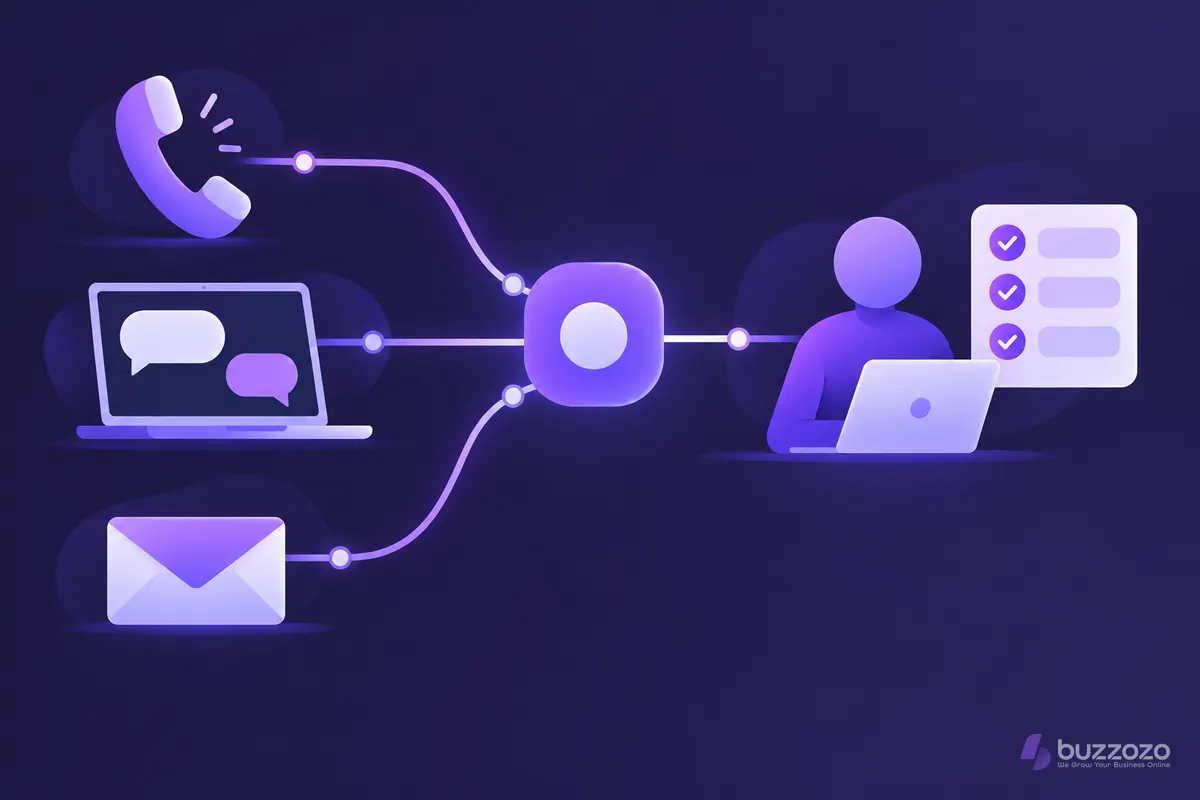
Use the same approved business facts across every channel, but adapt the handover to how the customer is contacting you. A caller needs a spoken explanation and a clear next step. A chat visitor needs a visible way to reach someone. A message needs an owner and a reply expectation.
- Phone: keep the opening brief, make it clear an AI assistant is answering, and test what happens when the caller interrupts or asks for a person.
- Web chat: keep answers short, link to the relevant service information and offer a form or human contact route.
- Messages: preserve the conversation context, avoid duplicate replies and assign follow-up to a named team member.
Do not make customers start again when they switch channels. Pass on a short, accurate summary and the question still awaiting an answer. Check that the person receiving it can actually see it. For the web channel, Buzzozo's business website chat assistants give you a starting point for routine questions.
Our guides to AI chatbots on business websites and what an AI receptionist does explain the individual tools. The customer-service job is making their answers and follow-up consistent.
When should a person take over?
A person should take over when the customer asks, the answer is uncertain, or the request needs judgement or authority the assistant lacks. Complaints, disputed bills and sensitive situations need clear escalation rules. Passing a message into an inbox is only useful when somebody owns the response.
Write the trigger and the action together. For example: if someone disputes a charge, stop explaining the standard price and pass the conversation to the billing owner. If the customer asks twice without getting an answer, stop repeating the same reply.
Out of hours, say what will happen next without inventing a callback deadline. Offer a working contact route and state the business's approved response expectation. Do not promise an immediate transfer when nobody is available.
Keep emergency instructions outside ordinary sales handling. Use a reviewed script appropriate to your sector rather than asking an AI assistant to improvise medical, legal or safety advice.
Rather have it done for you? We build your website free, it goes live in days, and you pay nothing for the first 14 days. No card needed. See how the free 14-day trial works.
What would a useful handover look like?
A useful handover tells the person what the customer needs, what has already been said and what remains unresolved. It gives the customer a clear next step. Test the handover all the way through to receipt by the responsible person, rather than stopping when the assistant says it has sent it.
Consider an illustrative repair business, not a Buzzozo customer case study. A caller asks whether it covers their postcode. The assistant checks the approved service-area list and explains how to request a visit. The caller then asks for a refund for an earlier job.
The assistant should stop the booking flow. It can collect the minimum contact details needed, record that a refund was requested and send that summary to the person authorised to review it. It should not approve the refund, promise an amount or ask for payment-card details.
Test this with invented details before launch. Ask the receiving team member to find the message, explain the next action and check the customer's contact route. That exposes gaps a polished demo can hide.
What UK data-protection checks come first?
Before using personal data, identify why you need it, the lawful basis and who handles it. Give customers clear privacy information, collect only what the task needs and set retention and access rules. Assess the risks of your particular use; buying an AI service does not remove your responsibilities.
The Information Commissioner's Office (ICO) AI accountability guidance explains responsibility, controller and processor roles, and impact assessments. Complete a data protection impact assessment before high-risk processing. If you conclude one is not required, document why. Ask your supplier who processes recordings and transcripts, where they go and whether they are used for model training.
For calls, decide whether audio is recorded or only transcribed. Explain the actual processing rather than using a generic recording announcement. For chat, make the privacy information accessible before collecting personal details. The ICO's transparency guidance covers explaining the purpose, retention and sharing of personal data.
The ICO also explains security and data minimisation in AI. A practical starting point is restricting transcript access and collecting only the details needed for the enquiry. Decide how recordings and summaries are removed when no longer needed.
These ICO pages are marked as under review following the Data (Use and Access) Act. Check the current guidance for your use before launch. This is a planning checklist, not an assessment that a particular setup complies with the law.
What should you measure after switching it on?
Measure whether customers get a correct answer and reach the right person when needed. Track unresolved enquiries, repeat contacts, handover receipt and time to a useful response. Check a sample of conversations for accuracy. A high automated-answer rate means little if customers have to contact you again.
- Accuracy: did the reply match the approved information at that time?
- Resolution: was the customer's question answered, or merely acknowledged?
- Handover: did the responsible person receive enough information to act?
- Follow-up: did the customer receive the promised next step?
- Experience: could someone ask for a person without getting stuck?
Keep a note of changes to answers and routing, so you can connect a problem with the version customers actually used. Review failed conversations before expanding the scope. Agree how to pause automated replies and use a normal contact route if answers become unreliable.
A managed business website gives the assistant a clearer starting point when its service details stay current. Buzzozo helps small businesses use AI around customer enquiries, with people checking the setup. Compare scope and usage on the current Buzzozo plans page.
If the website needs attention first, try a website free for 14 days. No card needed. Use the trial to check that customers can find an answer and send an enquiry before deciding what to automate.
Common questions
Can AI customer service replace every human reply?
It should not be your only route to help. Use it for agreed routine questions, with a person handling uncertainty, complaints and requests outside its authority. Make the human contact route easy to find and test it.
Should the same AI answer calls and web chat?
They can share approved business facts, but each channel needs its own handling and handover. Test spoken replies, chat links and message follow-up separately. Customers should receive consistent information whichever route they use.
What should I check before giving AI customer data?
Identify the purpose and lawful basis, check supplier roles, and explain the processing to customers. Limit what you collect, control access and retention, and assess the risks before launch. Review the current ICO guidance for your specific setup.