
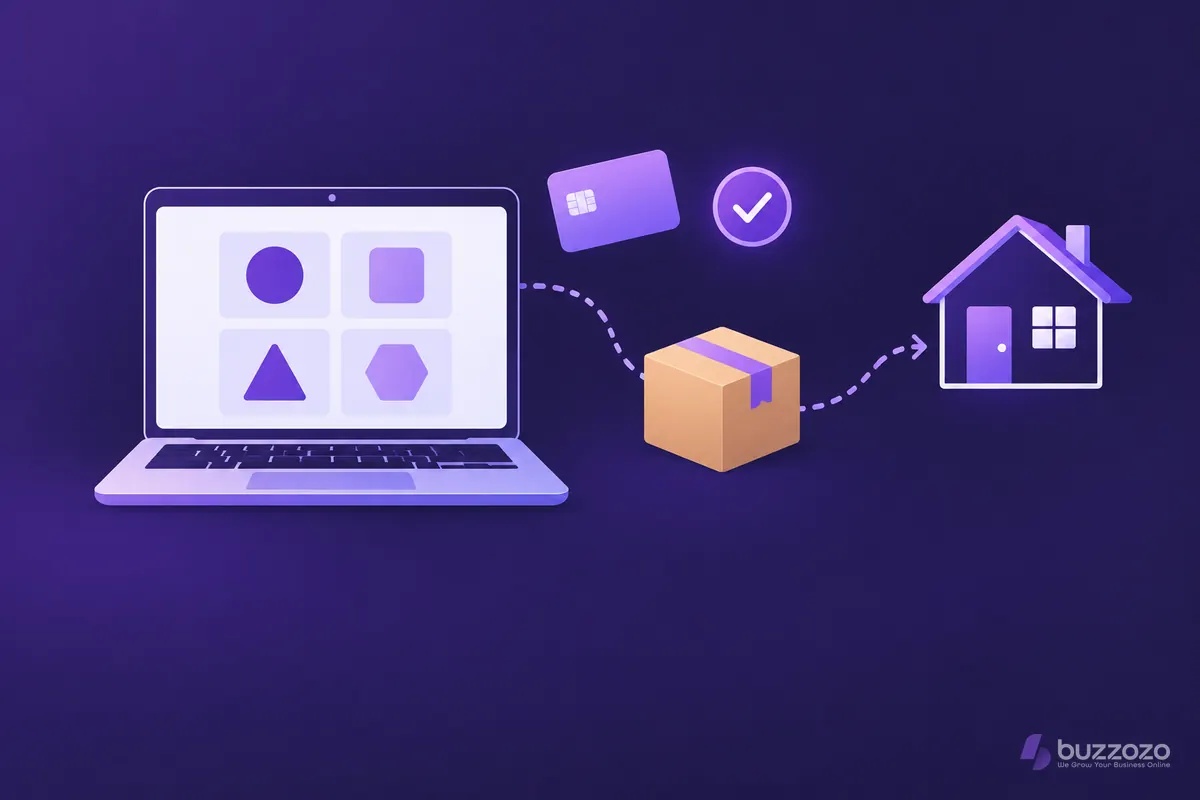
What are the steps to start an online shop?
There are seven steps, and most owners take them in this order. Each one feeds the next, so a gap early on tends to show up later as lost sales or extra work.
- Choose what you will sell and who will buy it.
- Work out the numbers for one order, from stock to postage.
- Set up the business with HMRC and check VAT.
- Plan delivery, returns and data so you meet the rules.
- Build the shop: product pages, checkout, payments and delivery rates.
- Test it end to end with real orders before launch.
- Bring in your first customers and keep improving.
If you are still deciding whether to sell online at all, start with our guide what is ecommerce for a UK small business. It explains how an online shop works from order to delivery.
How do you choose what to sell online?
Choose products you understand, that people already search for, and that you can post safely at a fair cost. A good first range is small. A handful of products done well beats a large range with thin pages and patchy stock.
Before you buy stock, ask yourself:
- Who exactly is the buyer, and where do they shop now?
- Why would they buy from you rather than a shop they already know?
- Can the product be posted without breaking, melting or costing a fortune?
- Will people want to return it, for example because of sizing?
- Can you get more stock quickly if it sells?
The second question matters most. Our guide to what a unique selling point is shows how to put that reason into one clear line. That line then shapes your product pages, photos and ads.
How do you work out if an online shop will make money?
Work out the profit on one typical order before you build anything. Start with the price the customer pays, then take off every cost that order creates. What is left has to cover your time, your shop and your advertising.
The costs of a single order usually include:
- what the product cost you to make or buy;
- packaging, labels and any printed inserts;
- postage, which can change with weight, size and speed;
- the card payment fee charged on each sale;
- VAT, if you are registered;
- a share of returns, refunds and damaged parcels.
Then add the monthly costs that do not change with each order: your website or shop, any apps or tools, insurance and advertising. Many new shops look busy and still lose money, because postage or returns quietly eat the margin. Getting this sum right first costs you nothing but an hour with a calculator.
Do you need to register a business to start an online shop?
Usually, yes, once you earn more than a small amount. Most online shops start as a sole trader or a limited company. A sole trader can start trading straight away, but must register for Self Assessment once they earn more than £1,000 in a tax year. A company must register before it trades.
The UK government's guide to setting up a business compares the two. As a sole trader you are personally responsible for all of the debts of the business. A limited company is legally separate from its owners, so they are responsible for its debts only up to the value of their investment. The guide also says it is usually easier to move from sole trader to limited company than the other way.
VAT comes next. HMRC's page on when to register for VAT sets the threshold. You must register if your taxable turnover for the last 12 months goes over £90,000. You must also register if you expect it to go over £90,000 in the next 30 days. You can choose to register earlier. Once registered, your prices and your shop's tax settings both need to reflect it.
Data is the third piece. An online shop stores names, addresses and order details. The Information Commissioner's Office (ICO) is the UK's data protection regulator. It explains that organisations, including sole traders, that use personal information need to pay a data protection fee unless they are exempt. Check the ICO's guidance to see whether that applies to you.
This is a general guide, not legal or tax advice. It points to the official guidance for each rule. For your own case, read the government and ICO pages linked here, or ask an accountant or a solicitor.
Rather have it done for you? We build your website free, it goes live in days, and you pay nothing for the first 14 days. No card needed. See how the free 14-day trial works.
What rules apply when you sell online in the UK?
When you sell to the public online, you must tell buyers certain things before they order, let them cancel, and send their goods on time. The government's guide to online and distance selling sets out what you must do, and what can happen if you do not.
Two points catch many new shops out:
- After an order, you must send the goods within 30 days, unless you have agreed otherwise with the customer.
- If you do not tell the customer about their right to cancel, they can cancel at any time in the next 12 months.
Plan these into the shop from the start. That means a clear delivery page, a returns and cancellation page, your business details in the footer, and a confirmation email the customer can keep. Our guide to website terms and conditions explains which policy pages a shop needs and who should write them.
What does a good online shop website need?
A good online shop answers every question a buyer has before they ask it. It loads quickly on a phone and lets them pay without a surprise. That is far more than a page of products with a basket. Every part needs care.
- Product pages: clear photos from several angles, honest descriptions, sizes, materials and delivery time on the page.
- Products and options: every size or colour set up with its own price, weight and stock count, so nothing sells that you cannot send.
- Checkout and payments: card payments and wallets set up and tested, with the full price shown early and no extra steps.
- Delivery and tax: delivery rates and zones that match what postage really costs, and tax settings that match your VAT position.
- Policy pages: delivery, returns, privacy and terms pages, linked from every page and from the checkout.
- Speed and search: fast pages on a phone, and product pages that search engines and AI assistants can read and match to real searches.
- Upkeep: updates, security checks, new products and fixes, every month, so the shop keeps working.
A shop is also still a website. The same custom web design for small businesses skills apply: clear layout, fast pages and words written for your customers. None of these is hard on its own. The skill is in getting all of them right together, and keeping them right as you add products and change prices. That is where most of the time goes.
Should you build your online shop yourself?
You can, and some owners enjoy it. But a shop that sells is a long list of small jobs, each easy to get slightly wrong. Is your time better spent making, buying or packing stock? Then having it built and run for you is often the faster route to steady sales.
Doing it yourself means learning a shop platform and setting up a theme. You add each product and option, edit photos, and set delivery and tax rules. Then you test the checkout on phones, write the policy pages, connect your payments and keep everything updated. A mistake in delivery rates or tax settings can cost money on every order until someone spots it.
If that list looks like a second job, it can be handed over. Our online shop design and build service does the heavy lifting. We design your store, load your products, set up payments and shipping, and keep it running, so you can get on with selling. Every store is different, so we quote after a quick chat about your products and what you need.
How do you test an online shop before launch?
Place real orders before any customer does. Buy a product on a phone and on a laptop, pay with a real card, and refund it. Then check that every email, stock count and delivery charge behaved as you expected.
Use this checklist on launch week:
- Place a test order for each delivery option and zone you offer.
- Check the total includes the right postage and tax at every step.
- Confirm the order email reaches the customer and you, and reads clearly.
- Refund one order and cancel another, to test the returns process.
- Open every page on a phone and check it loads quickly.
- Click every link in the header, footer and checkout.
- Check your business details and policy pages are easy to find.
How do you get your first customers for an online shop?
Start with people who already know you, then add search and ads. Tell existing customers, friends and followers the shop is open. At the same time, make sure each product page can be found in search, because that brings buyers who are already looking.
- Search: product and category pages with clear titles and descriptions help search engines match them to real searches. Our search engine optimisation (SEO) and AI search service does this for shops and websites.
- Shopping and search ads: paid listings that show your product, photo and price when someone searches.
- Social media: regular posts and short videos that show the product in use.
- Email: a simple list of past buyers, with their consent, for new products and offers.
Once orders arrive, questions follow. Where is my parcel? Will it fit? How do I return it? AI for ecommerce answers those questions on your website day and night, and passes refunds, returns and complaints to your team.
Not ready for a full shop yet? Start with the website. Our Website plan is from £149 a month at the founding price for the first 100 businesses. There is no contract, and you can cancel any time. See what it includes on our plans and prices page. The free 14-day trial covers a business website, and a store is priced separately. Many clients start with the free website and add a shop later. Start your free 14-day trial. No card needed.
Common questions
How long does it take to start an online shop?
Setting up an account takes minutes. Building a shop that is ready to sell takes much longer. You need products, photos, descriptions, delivery rates, payments, policy pages and testing. Most of the time goes on getting every product and setting right, and that grows with the size of your range.
Can I start an online shop from home?
Yes. Many UK online shops start from a spare room. Government guidance says you should check your responsibilities if you run your business from home. You may also need business insurance, and some products, such as food, need a licence or registration. Check the government guidance for what you sell.
Do I need a website to sell online?
You can sell through online marketplaces and social media without one. A website of your own lets you set your own prices, keep your own customer list and build your brand. Many small shops use both, with their own website as the main shop.
Do I need to register for VAT to sell online?
Not at first, for most small shops. HMRC says you must register when your taxable turnover for the last 12 months goes over £90,000. You must also register if you expect that in the next 30 days. You can choose to register earlier. Check HMRC guidance or ask an accountant for your case.