
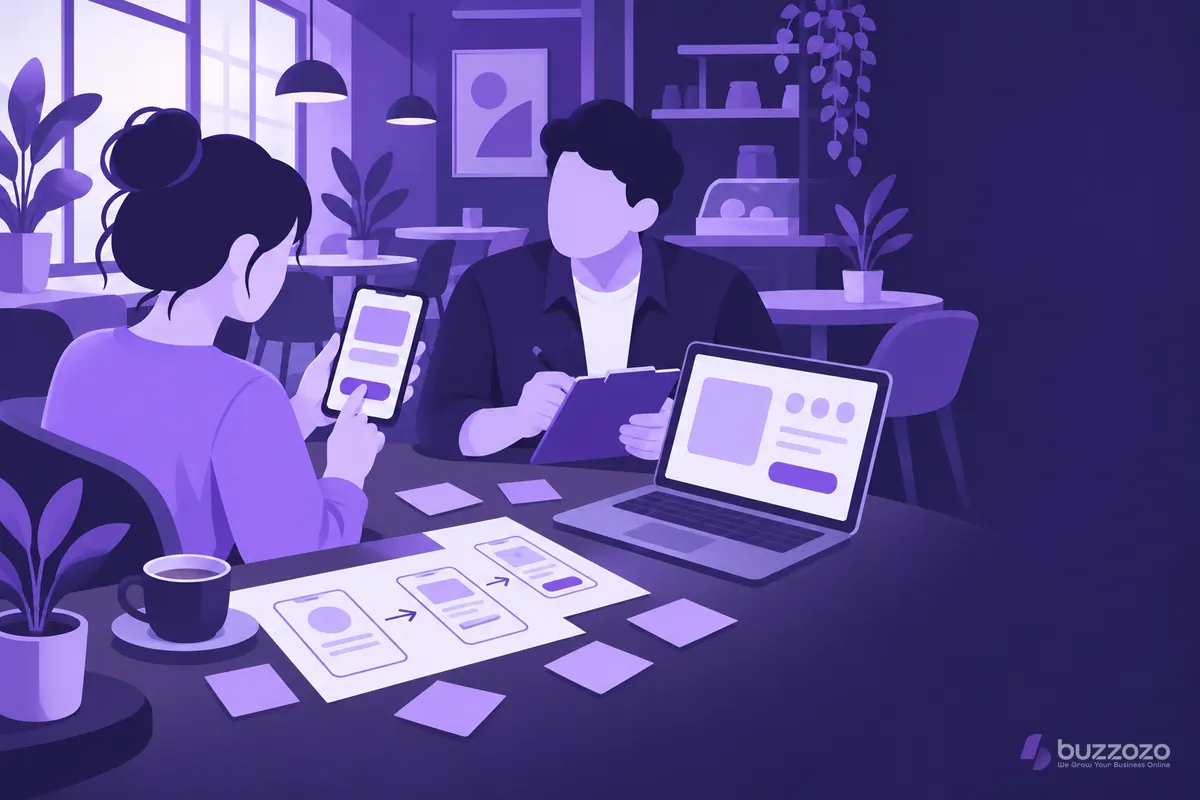
What does user experience design mean?
User experience design is the work of making a website or service easy for the people who use it. It is not the colours or the logo. It is whether a customer can find what they came for and understand it. Then it is whether they can finish the job, such as booking a visit or sending an enquiry.
The UK government's guide to learning what users need puts the starting point plainly. If you do not understand who your users are or what they need, you cannot build the right thing. UX design turns that understanding into pages, words, forms and steps.
So UX design has two halves. First you learn what your customers are trying to do. Then you design a path that lets them do it with as little effort as possible, and you check that it works.
What does UX research involve?
UX research is how you learn what your customers need before you design anything. That same guide asks teams to find out who their users are and what they are trying to do. It also asks about the problems or frustrations they meet along the way.
- Talk to real customers. Ask recent customers how they found you, what they were looking for and what nearly put them off.
- Treat guesses as guesses. The same guide says to treat any opinion that does not come from users as an assumption that has to be proven by research. That includes the owner's opinion.
- Write needs in the customer's words. "I need to know if you cover my postcode" is a user need. "Showcase our coverage area" is not.
- Map the journey. Experience maps show how a customer moves from first search to booked job, and where they drop out.
Research is not a one-off. The guidance says you must keep researching throughout each phase, so the service keeps meeting user needs as they change.
What is usability testing?
Usability testing means watching real people try to complete real tasks on your website. The government's guide to moderated usability testing describes it as watching participants try to complete specific tasks using your service.
A typical session follows a simple pattern.
- Recruit the right people. Participants need to be actual or likely customers, not friends who already know the business.
- Set a clear task. For example: "Your boiler has stopped working. Find out whether this firm can come today and ask for a visit."
- Ask them to think aloud. Hearing what someone is doing, thinking and feeling shows where the page confuses them.
- Test the website, not the person. Tell participants that if they get stuck, the fault lies with the design.
The guidance says sessions usually take between 30 and 60 minutes, depending on the number and complexity of the tasks. Each session ends with a list of specific problems, such as unclear wording or a confusing layout, that the design then has to fix.
Rather have it done for you? We build your website free, it goes live in days, and you pay nothing for the first 14 days. No card needed. See how the free 14-day trial works.
How is UX design different from responsive design or web design?
These three terms overlap, but they answer different questions. Mixing them up is how a site ends up looking smart on every screen while customers still cannot work out how to book.
- Responsive design answers "does the layout fit this screen?" The page rearranges itself for a phone, a tablet or a desktop. It is one part of a good experience, not the whole of it.
- Web design is the wider job of planning, designing and building the site: the look, the pages, the words and the code. Our guide to building a small business website walks through that whole process.
- UX design answers "can this customer do what they came to do?" It shapes the order of the pages and what each page says first. It also decides how many steps a form has and what happens after someone presses send.
A strong website needs all three. The UX work decides what the site has to do. The web design makes it look and feel right. Responsive design makes sure that holds up on the phone in your customer's hand.
Why does good UX design take real skill and time?
UX design looks simple from the outside, because the best result feels obvious. Getting there takes trained judgement and hours of careful work at every stage.
- Research takes planning. Choosing who to talk to, writing questions that do not lead the answer and turning interviews into clear needs is a skill of its own.
- Testing takes time. Each usability session runs 30 to 60 minutes, and someone has to plan the tasks, run the sessions and sort what they saw into fixes.
- Accessibility takes knowledge. The government's introduction to accessible services notes that in the UK, 1 in 5 people have a long-term impairment affecting everyday activities. Designing for screen readers, keyboard users and people on a slow connection in a noisy place is specialist work.
- Every fix needs checking. Change the wording on a form and you need to check again that customers still finish it.
The same accessibility guidance adds that problems usually cost less to fix when you find them early. That is the real value of UX work: it catches the problem before your customers do.
What does UX design look like on a small business website?
Take an imagined boiler repair firm in Nottingham. Its website gets visits but few enquiries. The design looks fine. The trouble is the path a customer has to follow.
Before:
- The home page opens with the firm's history. The phone number sits in the footer.
- Areas covered are listed on a separate page that most visitors never open.
- The enquiry form asks for twelve details, including the boiler's model number.
- On a phone, the "Book" button sits below three screens of text.
- After someone sends the form, nothing tells them what happens next.
After a UX review:
- The first line says what the firm fixes, where it works and how fast it can come out.
- A postcode check sits at the top of the page, so customers know straight away that they are covered.
- The form asks for four things: name, phone, postcode and the problem.
- A call button stays in view on phones.
- The thank-you message says when the firm will call back.
Not one of those changes is about colour or style. Each one removes a reason for a customer to give up. Our guide to getting more leads from your website covers more ways to turn visits into enquiries.
How can Buzzozo design your website around your customers?
We design it for you. Our web design service for small businesses starts with conversion-first design, built to turn visitors into enquiries. Every site is designed for your business and written for your customers, not a template with your logo dropped in.
We design for phones first, because most of your visitors are on one. We wire your forms and bookings straight into one inbox. Your trial also includes an AI chat assistant that answers visitors day and night and captures their enquiries, so nobody leaves without a reply.
The Website plan is from £149 a month at the founding price, which the first 100 businesses keep for life. After the first 100, it is from £299 a month. Want your enquiries and follow-ups in one place too? A customer relationship management (CRM) system for small businesses comes with the Website + CRM plan. Our website plans and prices list everything included. There is no contract and you can cancel any time.
You can see it working before you pay anything. Get your free website: we build it, it goes live in days, and you pay nothing for the first 14 days. No card needed, and you can cancel any time.
UX design usually starts with a simple website wireframe. After launch, conversion rate optimisation (CRO) tests whether the experience turns visitors into enquiries.
Common questions
Is UX design the same as user interface (UI) design?
No. UI design is the look of each screen: buttons, colours, type and spacing. UX design is the whole journey a customer takes to get something done. Good UI is part of good UX, but a beautiful screen can still sit inside a confusing journey.
Do small businesses need UX design?
Yes, if your website is meant to bring in enquiries. A small site has fewer pages, so each one matters more. If customers cannot find your phone number, your areas covered or your booking form quickly, they go back to the search results.
How many people do you need for usability testing?
There is no fixed number. Run a few sessions with real or likely customers, fix the problems they show you, then test again with new people in the next round. Each round makes the next problem easier to see.
How long does UX design take?
It depends on the size of the site and how much research it needs. A single usability session usually takes 30 to 60 minutes. Research, design and testing then repeat as the site grows, because customer needs change over time.