
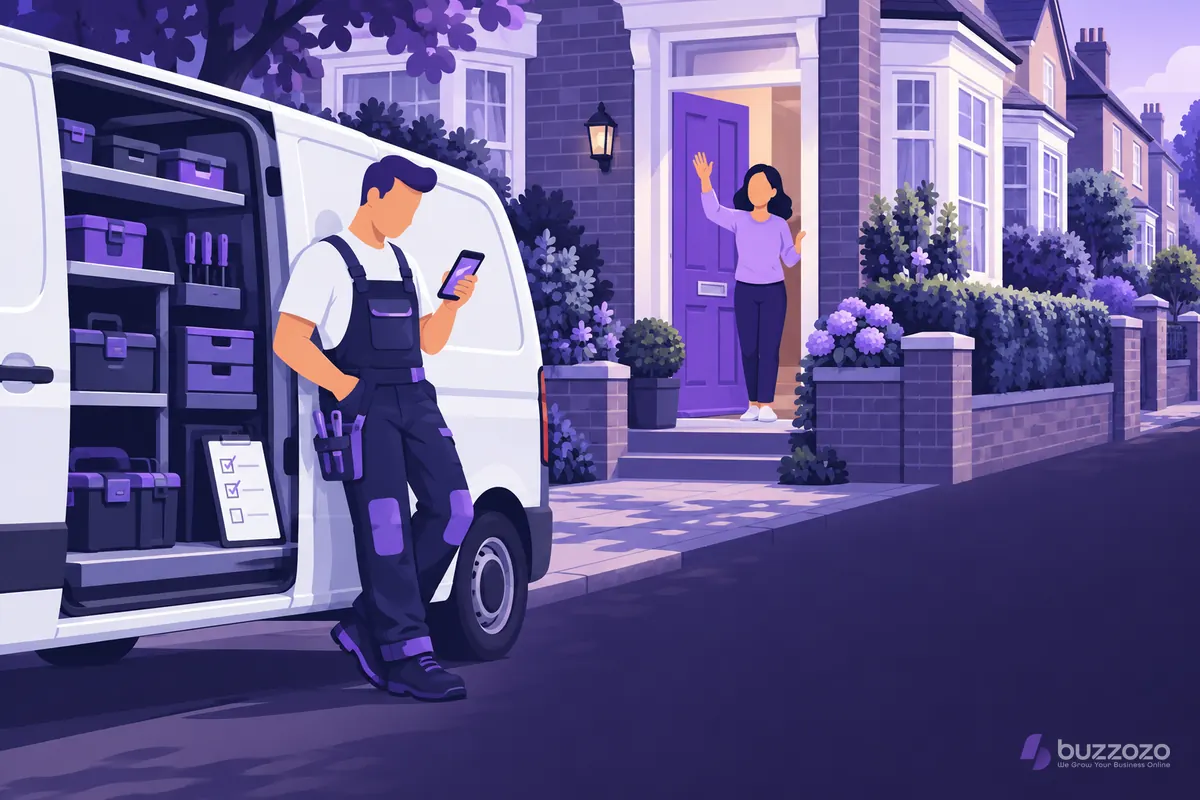
What does marketing for tradesmen actually involve?
It is everything that puts your name in front of local people at the moment they need your trade. For most trade businesses that means four things working together: a website, a Google Business Profile, reviews and repeat work from past customers.
Leaflets, van signs and trade directories still bring in some jobs. But even when a neighbour gave them your name, a customer may look you up on their phone before they ring. Whatever first made them hear of you, what they find online helps them decide whether to call.
Why does a trade business need its own website?
Because it is the one place online that is only about you. A directory profile puts you next to rival traders, on their layout and under their rules. Your own site, on a domain in your name, shows your work, your areas and your number with nothing else competing for attention.
A customer with a leaking pipe gives each site a few seconds. In that time they want to see the right trade, their town and a way to reach you. A good trade website gets these right:
- Your trade and the towns you cover on the first screen, in plain words.
- A tap-to-call button on every page, so nobody has to copy your number down.
- A clear section for each service, such as boiler installs, rewires or roof repairs.
- Proof people trust: the registrations you hold, your reviews and real photos of your own jobs.
- A quote form that asks for the job type, postcode and how soon they need you.
Our page on websites for tradesmen shows how each of these looks on a real trade site.
How does a Google Business Profile bring in local calls?
Your profile is what shows on Google Maps and in the local results when someone searches for a trade near them. Google's guide to improving your local ranking says local results mainly depend on relevance, distance and how well known your business is. It also says there's no way to request or pay for a better local ranking.
The same guide says businesses with complete and accurate information are more likely to show up in local search results. So fill in every part: your business category, the hours you work, your service areas and photos of finished jobs. It also counts how many websites link to your business and how many reviews you have. A website and steady reviews make your profile stronger.
Want to go deeper on search? Our guide to search engine optimisation (SEO) for tradesmen covers profiles, service pages and area pages.
How do you get more reviews without breaking the rules?
Ask every happy customer, straight after the job, and make it easy with a direct link. Google's own tips to get more reviews suggest sending customers a link or showing them a quick response (QR) code. They also say to reply to reviews, including the bad ones, calmly and briefly.
Never pay or reward anyone for a review. Google treats a free or discounted job in return for a review as fake engagement, and it is strictly prohibited. If you show reviews on your own website, the Competition and Markets Authority (CMA) also has rules for you. Its short guide for businesses that publish reviews says you should have a published policy that clearly prohibits fake reviews.
This is general guidance, not legal advice. If you are unsure what applies to your business, check with the regulator. Our reputation management service requests genuine reviews from real customers and watches what is said about you. It also flags reviews that break platform rules.
Rather have it done for you? We build your website free, it goes live in days, and you pay nothing for the first 14 days. No card needed. See how the free 14-day trial works.
How do you turn past customers into repeat work?
Keep in touch, because the easiest job to win is from someone who already trusts you. A reminder that a boiler service is due keeps your name in mind. So does a note when you start a new service, or a thank you after a big job. Happy customers also pass your name on to neighbours.
Texts and emails have rules. The Information Commissioner's Office (ICO) guide to electronic mail marketing covers texts and emails. You can contact an existing customer about similar services, if you gave them a clear chance to opt out. That chance must come when you took their details and in every message. People who never bought from you need to have agreed first.
- Write down each customer's consent or opt-out choice when you take their details.
- Put a simple way to stop messages in every text and email.
- Keep a list of anyone who opts out, and never message them again.
- Never buy lists of phone numbers or email addresses to market to.
Again, this is not legal advice: the ICO's guidance is the place to check what applies to you.
Which marketing should a tradesman do first?
Start with what a customer sees when they look you up, then build habits on top. Work through these in order:
- A clear website on your own domain, with your trade, towns and number on the first screen.
- A complete Google Business Profile with photos of real jobs and your hours.
- A habit of asking for a review after every finished job.
- Replies to every review within a few days, good or bad.
- Service reminders and updates for past customers who have not opted out.
- A way to see where each new enquiry came from, so you know what works.
Why does marketing a trade business well take skill and time?
Because each part needs regular care, and the work never shows up on a quote. A website needs the right words for each service and town, pages that load fast on a phone, and updates when you add a service. A profile needs fresh photos, correct hours and answers to questions customers post.
Reviews need asking for every week and replying to with care, especially the unfair ones. Messages to past customers need records of who agreed to hear from you. Then someone has to check which of it brings in calls and change what does not.
Each of those is a small job, but together they add up to hours every week. That is time most tradespeople spend on the tools, with family or doing quotes at night. Done in bursts, the gains fade. Done steadily, they keep the phone ringing in quiet months too.
What does good marketing look like for a local electrician?
Picture an electrician working across three nearby towns, who gets most work by word of mouth. Here is what steady marketing could look like for a business like that:
- A website with a page for each service, such as rewires and fuse boxes, and the three towns on the first screen.
- A complete profile with photos of tidy finished jobs, updated after the busiest ones.
- A review link sent by text after every finished job, and a short reply to every review.
- A yearly reminder to past customers who agreed to hear from them, with an easy way to opt out.
- A note of where each new enquiry came from, checked once a month.
None of it is complicated, but it all has to keep happening. That steady work is what makes a trade business easy to find and easy to choose.
How can Buzzozo market your trade business for you?
We do it for you. Our trade website service designs, writes and hosts a website for your trade. Your trade and towns go on the first screen with one-tap calls. We handle the hosting, security certificate (SSL), daily backups and updates. When you add a service or cover a new town, we add it to the site.
Your trial also includes an AI chat assistant. It answers questions about your services, areas and hours day and night, takes the customer's details and passes the job to you. On the Website + customer relationship manager (CRM) plan, callers you miss get a text back. That plan can also ask happy customers for a review once the job is done. For the map results, our local SEO service looks after your Google Business Profile, local website content and reviews.
The Website plan is from £149 a month at the founding price, which the first 100 businesses keep for life. After the first 100, it is from £299 a month. Our website plans and prices list everything included. There is no contract and you can cancel any time.
You can see your new site working before you pay anything. Get your free website: we build it, it goes live in days, and you pay nothing for the first 14 days. No card needed, and you can cancel any time.
Common questions
Do tradesmen still need a website if most work comes from word of mouth?
Yes. Someone who hears your name from a neighbour may still look you up before they call. A clear website with your trade, towns, reviews and number turns that recommendation into a call. Without one, they may ring the next name they find.
Can I pay to rank higher on Google Maps?
No. Local results depend on how well your profile matches the search, how close you are and how well known your business is. A complete profile, a good website and steady genuine reviews are what help.
Can I offer a discount in return for a review?
No. Rewarding customers for reviews breaks Google's review rules, and hiding that a review was rewarded can break consumer law too. Ask every happy customer instead, straight after the job, with a direct link.
Can I text past customers about a service reminder?
Often yes. They need to have bought from you, and you must have offered a clear way to opt out when you took their details. Every message must offer a way to stop too. This is not legal advice: check the ICO's guidance for your case.